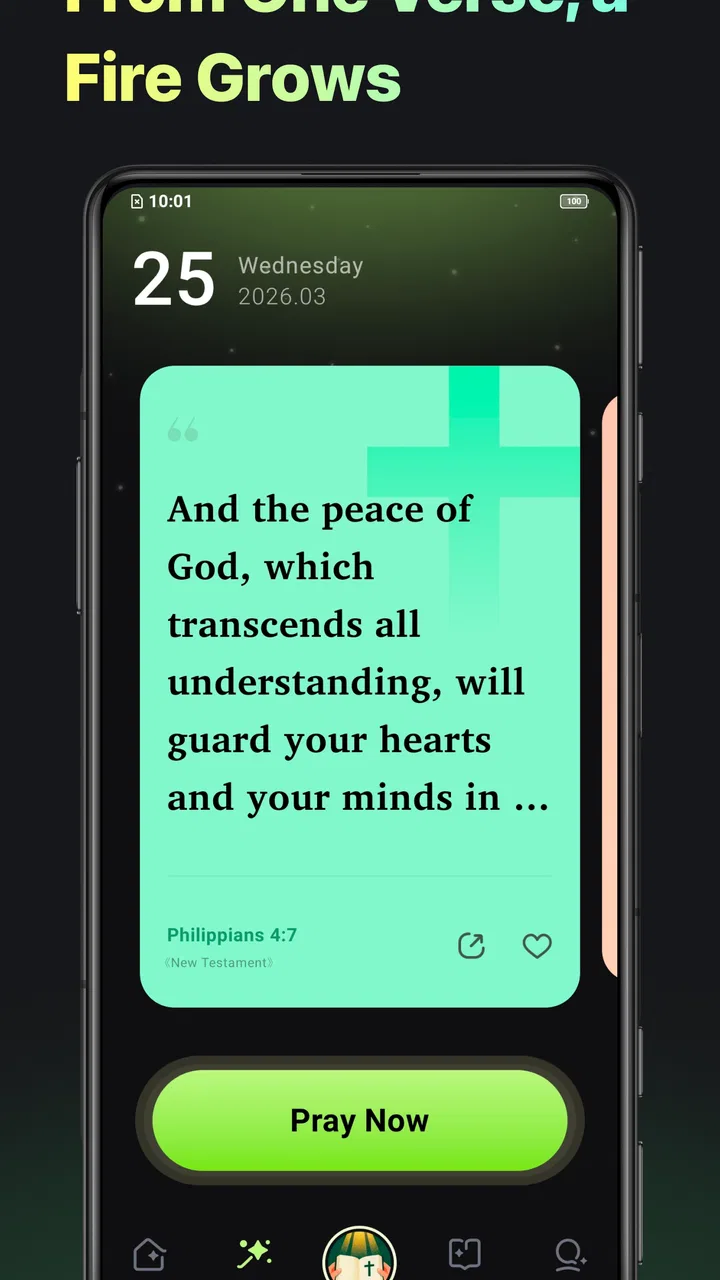
Ember: Walk With God
- 4.7
- Rating
- 100.00K
- Installs
- Free
- Price

 Analysis by App-foxy
I approached Ember: Walk With God as a small, practical companion for moments when I want Scripture, prayer, or a little guided reflection without opening a much larger religious platform. Its focus is easy to understand, but the experience depends heavily on how and where you use it. At home with a reliable connection, it feels straightforward. On a moving train, in a weak-signal building, or during a rushed break, the experience becomes more dependent on preparation and patience.
That distinction matters because this is a Books & Reference app, not a full replacement for every Bible, devotional, or church resource. WiseWakeTech has kept the idea focused around three activities: reading Scripture, spending time in prayer, and testing your knowledge through Bible quizzes. I found that combination more useful than a single-purpose reading app when I wanted a change of pace, although readers who need a very deep study tool may eventually want something more specialized.
The app is free and rated for Everyone, which makes it approachable for families, casual readers, and people who are simply curious. It has reached over 100 thousand installs and holds a 4.5 average from around 1.2 thousand ratings, so it already has a modest user base rather than feeling like an entirely untested experiment. The current version is 1.0.6, and it runs on Android 8.0 or later. I would still treat those figures as background context, not as a substitute for deciding whether its particular style fits your routine.
You May Also Like

 Blood Strike: 2.5 Anniversary
Blood Strike’s Loadouts Turn Every Drop Into a Tactical Gamble
A close look at Blood Strike’s custom loadouts: how fast access to signature weapons reshapes its battle royale rhythm, rewards preparation, and narrows the gap between fights.

 Pandora - Music & Podcasts
Pandora’s Music Is Easy to Start, but Harder to Recover
Pandora’s strength is its low-effort path from a seed to a station. Its weak spot is how much confidence it asks you to place in connection, setup, and quiet recovery.

 8 Ball Pool
 Is Built on Rivalries, Rematches, and Routine
A close look at the rivalries, rematches, shared routines, and unanswered safety questions that turn a quick pool match into a persistent mobile community.

 Samsung Music
’s Quiet Strength Is Playing What You Already Own
Its reach comes less from spectacle than from dependable access to a personal library. That simplicity is both the app’s strongest retention engine and its ceiling.

 AccuWeather: Weather Radar
AccuWeather Review: A Quick, Clear Forecast for Everyday Decisions
For everyday plans, the best forecast is the one you can understand quickly. AccuWeather makes rain timing, radar, and local conditions easy to act on, with a few trade-offs.

 Hill Climb Racing
Why Hill Climb Racing Still Turns Crashes Into One More Run
A tiny car, a bumpy hill and one more upgrade: Hill Climb Racing keeps resurfacing because its simple chaos makes every near-miss feel personal.
More From Our News Desk



How Ember feels when the connection is doing the work
The most important practical point is that the app’s usefulness is tied to the network moments involved in accessing its material. When a page or activity takes a moment to appear, the interruption is not disastrous, but it changes the mood. Prayer and Scripture reading are often quiet activities, and even a small wait can make the experience feel more like using a general mobile service than entering a calm reading space.
I noticed this most when switching between activities. A person may begin with a passage, move into prayer, and then try a quiz while waiting for a bus. That kind of short session is exactly where an app like this can be convenient, but it is also where connectivity becomes noticeable. If the signal is unstable, I would avoid tapping repeatedly or assuming that a delayed screen has ignored the first request. A slower, single-action rhythm is less frustrating and reduces the chance of accidentally repeating an action.
This is not a criticism of the idea itself. The three-part structure gives the app a useful rhythm. Scripture offers a reading anchor, prayer creates space for personal response, and the quiz adds a more active way to revisit what you have learned. The trade-off is that the experience is less predictable than carrying a physical Bible or using a thoroughly established reading app whose main job is instant text access.
For a dependable home routine, I would open the app before settling down, let the first screen finish loading, and then stay within one activity instead of jumping around unnecessarily. That simple habit makes the experience feel more deliberate. It also prevents a common mobile mistake: starting a reflective session while multitasking, then blaming the app when the real problem is an overloaded connection and too many competing tasks.
Scripture reading works best when you give it a clear purpose
I would not use the Scripture area as a substitute for serious study with multiple translations, extensive notes, or detailed cross-references. Ember is better suited to a focused reading moment. Before opening it, decide whether you want to read slowly, revisit a familiar idea, or use the passage as a starting point for prayer. That decision keeps the session from becoming a quick scroll through religious content.
One useful workflow is to read first without immediately testing yourself. Afterward, the quiz can serve as a memory check rather than the main event. This makes the two parts complement each other: reading supplies context, while questions reveal whether the main ideas stayed with you. If you begin with the quiz every time, you may turn the app into a knowledge test and miss the reflective side that makes it different from an ordinary trivia tool.
The limitation is depth. People who compare several translations, mark individual verses, build long-term study notes, or follow a structured reading schedule may find a dedicated Bible app more capable. Ember’s appeal is its compact blend, not an encyclopedic research environment. I appreciate that distinction because it prevents disappointment: it is a useful companion for a short session, not necessarily the one app I would keep open for an hour of theological study.
Prayer fits short mobile pauses, but the setting still matters
The prayer side makes the app especially suitable for small gaps in the day. I can imagine using it before work, during a quiet lunch, or at the end of an evening when I want a prompt to slow down. Those situations do not require a complicated workflow. What matters is having a clear intention and enough privacy to concentrate.
A realistic example would be a commuter who has ten minutes before arriving at work. Rather than trying to complete a long reading session, that person could open Ember, spend a moment with Scripture, and use the prayer section as a transition between home responsibilities and the working day. If the train enters a poor-signal area, the interruption may break concentration, so I would start the activity while the connection is stable rather than waiting until the last stop.
That same scenario shows who may not enjoy the app. Someone who needs a completely uninterrupted devotional tool in places with unreliable reception may prefer a physical book or an application whose offline behavior is clearly established for their needs. I would not build a routine around assuming that every part of Ember will be equally available in every network condition. The safer approach is to use it where the phone can communicate reliably, or to keep a separate offline resource for important moments.
There is also a social consideration. Because the app is rated for Everyone, it is approachable for a broad audience, but a shared family device may not provide the quiet or privacy that prayer requires. Younger users may enjoy the quiz element, while adults looking for personal reflection may prefer to use headphones, a quiet room, or a short scheduled period without notifications. The app can support a habit, but it cannot create the attention that the habit needs.
The quiz adds energy without replacing reflection
The Bible quiz is the feature that most clearly changes the pace. It gives the app a lightweight learning angle and can make Scripture more memorable for people who enjoy active recall. I found that its best use is after reading, when I wanted to check what I had actually absorbed instead of relying on the vague feeling that a passage looked familiar.
There is a useful trade-off here. A quiz can make a session more engaging, especially for families or study partners, but it can also encourage a score-first mindset. Correct answers are not the same as understanding, and remembering a detail does not automatically mean grasping the meaning of a passage. I would use the quiz as a prompt for discussion or review, not as a measure of spiritual progress.
For a parent or teacher introducing a short activity, the quiz may be more inviting than asking a child to read a long passage immediately. For an experienced Bible reader, it may feel too light if the goal is interpretation or detailed comparison. That difference is not a flaw; it simply defines the audience. Ember works best when the user wants a gentle mixture of reading, reflection, and recall rather than a formal course.
Using it on the move, recovering from interruptions, and protecting attention
Mobile context shapes the experience more than the simple store summary suggests. A phone is often used in fragments: one hand while walking, a few minutes before an appointment, or late at night when concentration is limited. Ember suits these short windows better than a long, demanding study session, but its three activities are not equally comfortable in every environment.
Reading Scripture is the easiest activity to fit into a quiet break because it can be approached at your own pace. Prayer needs more privacy and mental space, even if the interaction itself is brief. The quiz is the most tolerant of interruptions because it is more active, although losing your place during a question can still make the session feel disjointed. I would choose the activity based on the surroundings rather than opening the app with a fixed expectation.
On a crowded bus, for example, I would avoid beginning a prayer session if I knew I would be interrupted repeatedly. A quiz may be more realistic there, provided the connection is stable and I can read the screen comfortably. At home, the order can change: a passage first, prayer second, and quiz only if I still have the attention for it. This flexible approach is one of the app’s strengths because it does not force every visit into the same kind of use.
What to do when loading stalls or a session breaks
When a mobile app pauses during a network change, the first response should be simple: stop tapping, check whether the phone has a usable connection, and give the current action a moment. Repeated taps rarely improve a weak signal. If the screen remains stuck, I would close and reopen the app, then return to the activity rather than assuming the previous attempt completed.
This recovery routine is especially important during a quiz. If an answer does not appear to register, rushing into another tap can create confusion about whether the response was accepted. A calm retry is better than treating the delay as a wrong answer. For Scripture or prayer, I would also keep a physical bookmark or a brief mental note of where I stopped, because a disrupted session is easier to resume when I know the intended starting point.
That may sound basic, but it changes the emotional quality of the experience. A devotional app should not turn a poor signal into a source of irritation. The user cannot control every network transition, yet a prepared routine reduces the damage. I would regard this as a practical weakness of using any connected mobile resource for reflection, and a reason to keep expectations modest during travel.
Use less data by choosing the right moment
People managing a limited mobile plan should be thoughtful about when they use Ember. I would prefer a trusted Wi-Fi connection for longer sessions and avoid opening it repeatedly just to check whether something has changed. A single intentional visit is more sensible than many short launches, especially when the phone is already switching between networks.
Another useful habit is to decide what you want from the session before opening the app. If the goal is prayer, go directly there. If the goal is review, use the quiz after reading. This reduces aimless navigation and keeps both attention and data use focused. It also makes the app feel less like a feed and more like a tool with a purpose.
I would not recommend Ember as the only resource for someone who regularly studies in airplane mode, rural areas, underground stations, or buildings with poor reception. A printed Bible or a known offline-capable alternative is a better safety net for those situations. The important distinction is not whether the app is valuable; it is whether your usual environment allows its connected experience to remain dependable.
Who should choose it, and who should look elsewhere
I would recommend Ember to someone who wants a free, approachable way to combine Scripture, prayer, and Bible knowledge checks in one place. It is particularly suitable for short daily pauses, beginners who prefer a gentle starting point, families looking for a simple shared activity, and readers who enjoy changing between quiet and interactive modes.
I would be more cautious about recommending it to advanced students who need extensive study tools, users whose primary requirement is guaranteed access without a connection, and people who want a highly structured long-term reading plan. Those users may be happier with a dedicated Bible study application, a specialized devotional service, or a physical book. Choosing another option would not mean Ember failed; it would mean the user needs a different center of gravity.
WiseWakeTech deserves credit for keeping the concept recognizable. The app does not need to pretend to be a complete library to be useful. Its value comes from bringing three related activities together without charging for access. The current release, 1.0.6, suggests a relatively early stage, so I would judge it primarily as a focused companion and remain attentive to how smoothly it handles everyday interruptions in my own routine.
My final connectivity verdict
After using Ember in different kinds of mobile situations, my view is positive but conditional. The combination of Scripture, prayer, and quizzes gives me more variety than a basic reading app, and the free entry point makes it easy to try. The experience feels most natural when I begin with a clear purpose, use it in a stable network environment, and treat the quiz as reinforcement rather than the whole point.
The key trade-off is simple: Ember is convenient when the phone can stay connected, but it should not be treated as the only resource for uncertain reception. That is the advice I would give a friend. Use it at home, during a planned break, or in another place where the connection is reliable. Keep a separate fallback for travel and signal dead zones, and do not let a loading delay turn a reflective moment into a technical battle.
For me, that balance makes the app worth trying. It is not the strongest choice for deep Bible research or guaranteed offline use, but it offers a friendly way to move from reading to prayer and then to recall. If that compact rhythm matches what you want from a Scripture and prayer app, Ember: Walk With God is a sensible addition to your phone, especially when used intentionally rather than casually opened in the middle of a bad connection.
FAQs for Ember: Walk With God
01What is Ember: Walk With God about?
Ember: Walk With God is an immersive spiritual journey app designed to enhance your daily devotional practice. It offers a series of guided meditations, scripture readings, and reflective exercises aimed at deepening your connection with your faith. The app is suitable for individuals seeking a structured approach to spiritual growth and mindfulness.
02Is Ember: Walk With God available on both Android and iOS?
Yes, Ember: Walk With God is available for download on both Android and iOS platforms. This ensures that users can access the app's features regardless of their device, allowing for a seamless experience across different smartphones and tablets. Links to download the app can be found on our website.
03What features does Ember: Walk With God offer?
Ember: Walk With God includes a variety of features such as daily devotionals, scripture readings, guided meditations, and community discussion forums. These features are designed to support users in their spiritual journey, offering a comprehensive toolkit for reflection, learning, and sharing insights with others.
04Are there any in-app purchases or subscriptions required?
While Ember: Walk With God offers a range of free content, some premium features may require in-app purchases or a subscription. These could include additional devotional content, personalized meditation plans, or exclusive access to community events. This model allows users to tailor their experience based on their needs and preferences.
05How user-friendly is Ember: Walk With God for beginners?
Ember: Walk With God is designed with user-friendliness in mind, making it accessible for beginners. The app features intuitive navigation, clear instructions, and supportive community forums. It caters to both newcomers to digital devotional tools and seasoned users, ensuring a welcoming and enriching experience for all.
Pros
- Beautifully designed interface.
- Comprehensive spiritual content.
- Easy navigation and user-friendly.
- Regular updates with new features.
- Offline access available.
Cons
- Limited customization options.
- Requires a stable internet connection.
- Some content behind a paywall.
- Occasional app crashes reported.
- Lacks interactive community features.

Ember: Walk With God
Gallery